If you walked into a Christian church in the year AD 100, what would you find?
Would you find a pastor preaching a sermon, leading a few songs, and encouraging everyone to study their Bibles?
Or would you find a bishop, presbyters, and deacons gathered around an altar, celebrating the Eucharist, baptizing new believers, and administering the mysteries of the Christian faith?
For many modern Christians, especially those raised in Protestant or evangelical traditions, the idea that the earliest Church had priests seems strange.
I understand that perspective. Coming from a Protestant background myself, I was taught that the priesthood belonged to the Old Testament. Jesus Christ had fulfilled the sacrificial system, becoming our Great High Priest, and therefore Christian priests were no longer necessary.
The argument sounded reasonable.
After all, doesn’t the New Testament call Jesus our High Priest? Doesn’t St. Peter teach that all believers are a royal priesthood? And when St. Paul describes the leadership of the Church, doesn’t he speak about elders and overseers rather than priests?
These are legitimate questions, and they deserve serious biblical and historical answers.
But something remarkable happens when we move beyond our modern assumptions and begin examining how the first Christians actually understood the Church.
We discover bishops, presbyters, and deacons. We discover the laying on of hands and an identifiable succession of ministers. We discover the Eucharist understood as the Body and Blood of Christ, the language of sacrifice, the authority to administer the sacraments, and a Church organized around worship rather than preaching alone.
And we discover these things extraordinarily early in Christian history.
So, were there priests in the early Church?
Yes. But to understand the answer properly, we must first understand what the early Christians meant by a priest, what St. Paul actually wrote, and how the priesthood of the Church relates to the one eternal priesthood of Jesus Christ.
1. The First Problem: We Are Asking an Ancient Question with Modern Definitions
When someone tells me, “There were no priests in the New Testament, only elders,” my first response is usually a question:
What exactly do you think the word priest means?
Because much of the disagreement comes down to language.
The New Testament was written in Greek, not English. And the Greek language uses several distinct words to describe religious leadership.
Three of them are especially important.
This word literally means an older man or elder. Within the Church, it came to describe someone holding a recognized position of spiritual leadership.
Presbyteros (πρεσβύτερος): Elder
It is the word from which we get presbyter, and historically, through the development of the English language, our word priest.
Episkopos (ἐπίσκοπος): Overseer or Bishop
This word refers to someone entrusted with oversight or supervision. It is the origin of our English word bishop.
Hiereus (ἱερεύς): Priest
This is the ordinary Greek word used for a priest in the sacrificial or cultic sense, particularly the priests serving under the Old Covenant.
And here is where we need to be careful.
When St. Paul discusses Church leadership in Timothy and Titus, he primarily uses presbyteros and episkopos. He does not simply identify these ministers with the Old Testament hiereis.
Some Protestant Christians correctly observe this distinction and conclude that the early Church had elders but not sacramental priests.
But that conclusion moves too quickly.
The fact that St. Paul uses a word meaning elder does not, by itself, tell us everything about the elder’s ministerial responsibilities.
A title identifies an office. The responsibilities, worship, and historical setting help explain what that office involves.
It is equally important to acknowledge that the English word priest did not originally mean exactly the same thing as the Greek word hiereus. It developed through the language of presbyteros.
In other words, the historical connection between presbyter and priest is real. But the English etymology alone does not prove a sacrificial priesthood.
For that, we have to examine Scripture and the worship of the early Church.
And that is precisely where the evidence becomes interesting.
2. What Did St. Paul Mean by Presbyter in Timothy and Titus?
Let’s begin with one of the clearest passages in the New Testament.
In Titus 1:5, St. Paul explains why he left Titus on the island of Crete:
“This is why I left you in Crete, that you might amend what was defective, and appoint elders in every town as I directed you.”
The word translated as elders is presbyterous, the accusative plural of presbyteros.
Notice several important details.
First, these elders are not merely older Christian men who happen to be respected by their neighbors.
They are appointed.
The Greek verb is kathistēmi, which, in this context, means to appoint or establish someone in an office or position.
Second, Titus is given responsibility for seeing that these appointments are made.
Third, the appointments are connected to the organization and order of the local churches.
This is not simply a spontaneous gathering of Christians choosing whoever wishes to lead a Bible study.
St. Paul is describing an organized Church with recognized leaders and apostolic direction.
And then something even more interesting happens.
In Titus 1:6, St. Paul continues describing the qualifications of these elders. But in verse 7, he says:
“For a bishop, as God’s steward, must be blameless.”
The word translated here as bishop is episkopos.
Look carefully at the movement of Paul’s argument.
In verse 5, he tells Titus to appoint presbyteroi.
In verse 7, he describes the qualifications of an episkopos.
Why would Paul move between these terms?
The most natural reading is that, at this stage of the Church’s development, the terminology of elder and overseer substantially overlapped.
This is also evident in Acts 20:17 and 20:28, where St. Paul summons the elders of the Church of Ephesus and subsequently describes their responsibility as overseers who must shepherd the Church of God.
Does this mean bishops and priests were originally identical?
Not necessarily in every respect. But it does mean we should be careful about projecting the later, fully developed distinction between bishops and presbyters into every New Testament passage.
In the apostolic period, terminology was still developing.
The office of oversight, the ministry of elders, and the apostolic authority to appoint and direct Church leaders were already present. The consistent threefold terminology of bishop, presbyter, and deacon becomes especially clear in the early second-century writings of St. Ignatius of Antioch.
This is an important distinction.
The Orthodox Church does not need to pretend that every aspect of its later ecclesiastical terminology appears in finished form in the New Testament.
The question is whether the ministry of the historical Church developed in continuity with the apostles.
And as we will see, the evidence for that continuity is substantial.
3. What Does Paul Tell Timothy About the Ministry of the Church?
Now consider Paul’s instructions to Timothy.
In 1 Timothy 3:1-7, Paul describes the qualifications of an episkopos, an overseer.
This man must be spiritually mature, above reproach, capable of teaching, and able to govern his own household responsibly.
The emphasis is striking.
Paul is not describing someone who has simply demonstrated public-speaking ability.
He is describing someone entrusted with the spiritual care of God’s household.
That language matters because Paul has already described the Church as something far greater than a voluntary religious association.
In 1 Timothy 3:15, he calls the Church:
“The church of the living God, the pillar and bulwark of the truth.”
Think about that.
The Church is not merely a collection of individuals who share similar religious opinions.
It is the household of God.
It possesses a visible order.
It has recognized spiritual leadership.
And it has been entrusted with the truth of the apostolic faith.
Presbyters have an actual ministry
In 1 Timothy 5:17, Paul writes:
“Let the elders who rule well be considered worthy of double honor, especially those who labor in preaching and teaching.”
Again, the word is presbyteroi.
Notice that these elders exercise recognized leadership. They govern, teach, and serve the Church.
Paul continues by describing how accusations against elders should be handled, how sin must be addressed, and the importance of caution in laying hands on others.
In verse 22, he instructs Timothy:
“Do not be hasty in the laying on of hands.”
The immediate context concerns ministerial discipline and appointment, making ordination a significant traditional interpretation of this instruction, although the verse does not spell out every detail of the rite.
Then consider 1 Timothy 4:14:
“Do not neglect the gift you have, which was given you by prophetic utterance when the council of elders laid their hands upon you.”
The phrase council of elders translates presbyterion.
This refers to a recognized body of presbyters.
Here we see a ministry that involves more than someone standing before a congregation to explain Scripture.
We see spiritual responsibility, recognized authority, and the transmission or recognition of ministry through the laying on of hands.
In 2 Timothy 1:6, Paul reminds Timothy to rekindle the gift of God that came through the laying on of Paul’s hands.
The Church has historically understood these passages as important scriptural foundations for ordination.
And while the New Testament does not provide a complete ordination service, the essential elements of an ordered ministry are already visible.
The ministry is received, not merely claimed.
It is exercised within the Church, not independently of it.
And it is accountable to the apostolic faith.
But we still have another question to answer.
What does any of this have to do with the sacraments?
That brings us to something I believe is frequently overlooked.
4. The Early Church Was Sacramental Before It Was Institutionalized
One of the great misunderstandings of early Christianity is the assumption that the Church began as a simple preaching ministry and only later developed sacraments, liturgy, and priesthood.
But the New Testament itself presents a different picture.
Look at Acts 2:42:
“And they devoted themselves to the apostles’ teaching and fellowship, to the breaking of bread and the prayers.”
Notice the four things that characterize the earliest Christian community.
There is apostolic teaching. There is fellowship. There is the breaking of bread. And there are prayers.
These are not competing activities.
They are the shared life of the Church.
The apostles did not simply preach about Jesus. They baptized. They laid hands upon believers. They celebrated the breaking of bread. They prayed for the sick. They exercised spiritual authority.
In Acts 8:14-17, Peter and John travel to Samaria and lay hands upon baptized believers, who receive the Holy Spirit.
In Acts 19:5-6, Paul baptizes disciples and lays hands upon them.
In Acts 14:23, Paul and Barnabas appoint elders in the churches.
And in James 5:14-15, we find a particularly important passage:
“Is any among you sick? Let him call for the elders of the church, and let them pray over him, anointing him with oil in the name of the Lord.”
Who are these elders?
Once again, the Greek uses presbyterous.
And what are they doing?
They are performing a sacred action involving prayer and anointing with oil.
St. James does not merely tell the sick person to find any Christian willing to pray.
He specifically directs the sick person to summon the presbyters of the Church.
Why?
Because the presbyters exercise a recognized ministry within the community.
This is one of the biblical foundations of the Orthodox sacrament of Holy Unction.
Does that mean James 5 contains every detail of the modern Orthodox service of Holy Unction?
Of course not.
But the essential pattern is already present.
The sick person is brought into the prayer of the Church. The presbyters minister to that person. Oil becomes a tangible instrument associated with God’s healing grace.
This is exactly how the Orthodox Church understands sacramental life.
God works through His creation.
Water is involved in baptism.
Oil is involved in anointing.
Bread and wine are involved in the Eucharist.
And human beings, called and ordained to serve, become instruments through whom Christ ministers to His people.
The priest does not manufacture grace.
He does not possess some independent spiritual power apart from Jesus Christ.
He is a servant through whom Christ acts within the life of His Church.
This is a fundamentally different understanding of ministry from the idea that a pastor’s primary function is to preach a weekly sermon.
Preaching is essential. Teaching is essential.
But the Church was never meant to be a classroom alone.
It is the Body of Christ, where believers are brought into communion with God.
5. The Eucharist: The Key to Understanding the Christian Priesthood
If we want to understand why the early Church developed and preserved a sacramental priesthood, we must understand the Eucharist.
Because the Eucharist was never intended to be an optional religious illustration.
At the Last Supper, Jesus took bread, blessed it, broke it, and gave it to His disciples, saying:
“This is my body which is given for you. Do this in remembrance of me.” (Luke 22:19)
The word translated as remembrance is anamnesis.
In ordinary Greek it means remembrance or recollection. But within the biblical and liturgical setting, remembrance has a deeper significance.
In the Old Testament, God’s saving deeds were remembered through sacred actions.
Consider the Passover.
In Exodus 12:14, God commands Israel to observe the day as a memorial throughout their generations.
The Passover was not merely an annual history lesson about something that happened in Egypt.
It was a sacred participation in Israel’s covenant identity and God’s saving deliverance.
When Christ institutes the Eucharist during the context of His Passion and the Passover, this background matters.
He is establishing the New Covenant in His own Blood.
And He commands His disciples to continue this sacred action.
St. Paul describes participation in Christ’s Body and Blood
In 1 Corinthians 10:16, Paul asks:
“The cup of blessing which we bless, is it not a participation in the blood of Christ? The bread which we break, is it not a participation in the body of Christ?”
The Greek word translated as participation is koinonia.
It means communion, fellowship, or sharing.
Paul is not describing an ordinary social meal.
He is describing communion with the Body and Blood of Christ.
Then, in 1 Corinthians 10:18-21, he develops the argument by comparing participation in sacrificial meals with the table of the Lord.
He speaks of the altar and of participation in what is offered.
This does not mean Paul is saying that Christians repeat the animal sacrifices of the Old Testament.
He is drawing upon sacrificial language to explain the seriousness of Eucharistic communion.
And in 1 Corinthians 11:27-29, he warns that receiving the Eucharist unworthily brings judgment upon the person who fails to discern the Body.
Think about the weight of those words.
If the Eucharist were simply ordinary bread and wine used to help Christians remember Jesus, why would Paul describe unworthy reception in such serious terms?
The Orthodox understanding is that the Eucharist truly communicates Christ’s Body and Blood, and therefore our participation must be approached with repentance, faith, and reverence.
Here we begin to understand the relationship between the Eucharist and the priesthood.
The Church did not create a priesthood because it wanted a religious hierarchy.
Its ordained ministry grew within a community already gathered around the Eucharist, apostolic teaching, and the sacred mysteries.
The priest’s ministry is inseparable from that worship.
And the historical testimony of the earliest Christians confirms this connection.
6. The Didache: An Ancient Witness to Sacrificial Worship
One of the most fascinating documents in early Christian history is the Didache.
The title means Teaching, and the work is commonly known as The Teaching of the Twelve Apostles.
Scholars debate its precise date and the stages of its composition, but it is generally placed within the early centuries of Christianity, with much of its material often associated with the late first or early second century.
It is one of our earliest surviving windows into Christian worship and communal life.
And what do we discover?
In chapter 14, the Didache instructs Christians to gather on the Lord’s Day, confess their sins, and break bread in thanksgiving.
It describes the gathering in terms of a pure sacrifice, drawing upon Malachi 1:11.
That Old Testament passage declares that God’s name will be great among the nations and that a pure offering will be made to Him.
For the earliest Christians, this language was deeply significant.
The Eucharistic assembly was not an informal gathering without sacred meaning.
It was associated with the offering foretold by the prophet.
Then, in chapter 15, the Didache tells Christian communities to appoint bishops and deacons who are worthy of the Lord.
It also describes prophets as chief priests in chapter 13, using priestly imagery for a ministry that belonged to its early community setting.
We should acknowledge that the Didache does not set out a fully developed theology of the later Orthodox presbyterate. Its description of prophets, bishops, and deacons reflects an early period in which some ministries were organized differently across Christian communities.
But that makes its testimony more valuable, not less.
It shows the Church’s sacrificial language and recognized ministries at a remarkably early stage.
We are not reading a medieval liturgical manual.
We are reading ancient Christian instruction from a period close to the apostles themselves.
And the language of Eucharist, sacrifice, ordained leadership, and communal worship is already present.
7. St. Clement of Rome: Apostolic Succession Before the End of the First Century
Now let’s turn to one of the most important witnesses in the entire discussion.
Around AD 96, the Church of Rome addressed a serious dispute in the Church of Corinth.
Certain legitimate Church leaders had been removed from their ministry.
St. Clement of Rome wrote to address this disorder.
The resulting document, known as First Clement, is particularly significant because it was written while the apostolic generation was still within living memory.
Clement discusses how the apostles established ministers in the churches.
In chapter 42, he explains that the apostles appointed bishops and deacons among their converts.
Then, in chapter 44, Clement says that the apostles made provision for approved men to succeed these ministers after their deaths.
Consider what this means.
Clement does not teach that each generation should abandon previously established ministry structures and simply create new ones according to its preferences.
He describes continuity.
The apostles appointed ministers.
Those ministers served the churches.
And provision was made for their ministry to continue.
This is a foundational early witness to what the Orthodox Church calls apostolic succession.
Apostolic succession is not simply the ability to trace a historical list of names.
It is the continuity of the Church’s ministry, faith, and sacramental life through successive generations.
Clement also uses the language of priestly worship
In chapters 40 and 41, Clement draws upon the ordered worship of the Old Testament.
He refers to the high priest, priests, Levites, and laity, emphasizing that sacred duties are not performed arbitrarily.
He then applies this concern for divinely appointed order to the ministries of the Christian Church.
We should be precise here.
Clement’s direct references to high priests, priests, and Levites concern the Old Testament system. He is using that system as an analogy for ordered Christian ministry.
He does not simply declare that every Christian presbyter is identical to a Levitical priest.
Nevertheless, his argument is unmistakably relevant.
Clement sees sacred order as important to Christian worship.
He believes the apostles established a ministry that should be respected.
And he condemns the unjust removal of ministers who have faithfully performed their duties.
This is not the language of an unstructured religious movement.
It is the language of a Church that understands ministry as something entrusted and preserved.
For those who believe that apostolic succession was invented centuries later, First Clement presents a serious historical challenge.
We have explicit testimony of continuity in ministry before the close of the first century.
8. St. Ignatius of Antioch: The Bishop, Presbyters, Deacons, and Altar
If First Clement gives us an early witness to succession, St. Ignatius of Antioch gives us an extraordinary picture of sacramental ministry.
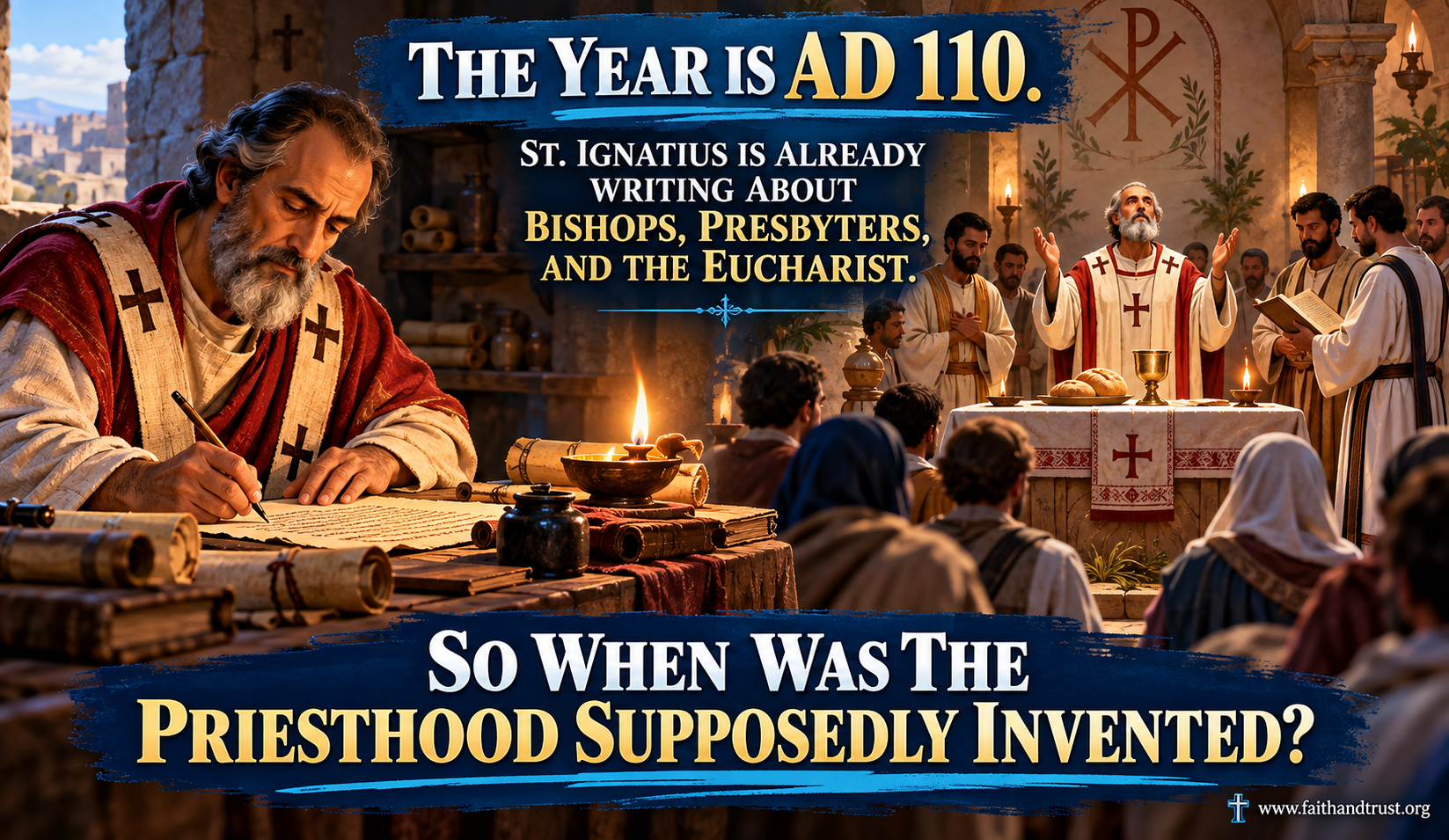
Ignatius was the bishop of Antioch and wrote several letters to Christian churches while being taken to Rome for martyrdom, generally dated to the early second century, around AD 110.
These letters are among the most important documents for understanding the organization and worship of the post-apostolic Church.
And what does Ignatius describe?
A Church with bishops, presbyters, and deacons.
But even more importantly, he directly connects this ministry to the Eucharist.
In his Letter to the Philadelphians, chapter 4, Ignatius urges Christians to maintain one Eucharist, one altar, and unity with the bishop, presbytery, and deacons.
Let’s consider what he is saying.
The unity of the Church is not merely agreement about a set of doctrines.
It is expressed sacramentally.
The Church gathers at one altar.
The people receive one Eucharist.
And the ordained ministry serves as a visible center of that unity.
The Eucharist is not simply something anyone decides to administer
Now look at Ignatius’s Letter to the Smyrnaeans, chapter 8.
He instructs Christians to follow the bishop, respect the presbytery, and honor the deacons.
He then says that the Eucharist is to be regarded as properly celebrated when it is conducted by the bishop or by someone authorized by him.
He also connects baptism and the Church’s communal sacramental life with episcopal oversight.
This is enormously important.
We have an early second-century Christian bishop explicitly connecting the proper celebration of the Eucharist with the authority of the bishop and those to whom he delegates responsibility.
That is not an invention of the Middle Ages.
That is not something established by the Roman Empire.
That is not a doctrine that appeared for the first time centuries after the apostles.
It is documented in the earliest decades of the second century.
And remember, Ignatius is not writing a lengthy theological defense of why Christians should have bishops and presbyters.
He speaks about these ministries as an established reality.
This does not prove that every Christian community everywhere possessed precisely the same organizational structure at that exact moment.
But it decisively establishes that the sacramentally ordered ministry later associated with Orthodox Christianity was already present very early.
Ignatius believed the Eucharist was truly Christ’s flesh
The connection becomes even clearer when we read the preceding chapter of his letter to the Smyrnaeans.
In chapter 7, Ignatius criticizes those who refuse the Eucharist because they do not confess it to be the flesh of Jesus Christ.
In other words, Ignatius does not regard the Eucharist as a mere symbol.
He understands it as the actual participation in the flesh of the incarnate Lord.
Put these statements together.
Ignatius believes the Eucharist is truly the flesh of Christ.
He connects its celebration with the bishop or someone appointed by him.
He describes presbyters and deacons as distinct ministers serving within the Church.
And he identifies the unity of the Church with unity around the Eucharistic altar.
Brothers and sisters, that should cause us to reconsider the popular claim that early Christianity consisted primarily of informal congregations led by independent preachers.
The historical evidence simply does not support that as a complete description of the early Church.
By the beginning of the second century, a recognizable sacramental and hierarchical structure was already clearly present.
9. St. Justin Martyr: What Did Christian Worship Look Like in AD 155?
Let me take you one step further.
Imagine we could travel back to approximately AD 155 and attend a Christian worship service.
What would we see?
Thankfully, we do not have to guess.
St. Justin Martyr, an early Christian philosopher and apologist, described Christian worship in remarkable detail in his First Apology, chapters 65-67.
Justin explains that Christians gather on Sunday. The writings of the apostles and prophets are read. The person presiding over the assembly teaches and exhorts the congregation.
Then the people pray.
Bread, wine, and water are brought forward.
The presiding minister offers prayers and thanksgiving.
The congregation responds with Amen.
And the deacons distribute the Eucharist, including to those who cannot attend.
Does that sound familiar?
For anyone who regularly attends the Orthodox Divine Liturgy, the similarities are remarkable.
We recognize the reading of Scripture, the homily, the common prayers, the Eucharistic offering, and the distribution of Holy Communion.
But Justin tells us something else.
In chapter 66, he explains that Christians do not receive the Eucharist as ordinary food and drink. They understand it to be the flesh and blood of Jesus Christ.
This is not a symbolic interpretation in which the bread merely reminds someone of Jesus.
Justin explicitly distinguishes the Eucharist from common bread and common drink.
Notice also that Justin does not identify the presiding minister using the later, more specific English title of priest. He uses the language of the one who presides.
Therefore, we should not misrepresent his testimony.
His writings establish a structured Eucharistic assembly with an identifiable presider and deacons. Read alongside Ignatius, they provide powerful evidence of a sacramental ministry in the early second-century Church.
And that sacramental pattern has been preserved in Orthodox worship.
The details of liturgical expression developed over time, but the underlying structure is astonishingly recognizable.
10. St. Irenaeus: The Eucharist as the Offering of the Church
By the latter part of the second century, the connection between Eucharist, sacrifice, and the apostolic Church becomes even more explicit.
St. Irenaeus of Lyons, writing around AD 180, discusses the Eucharistic offering in Against Heresies, Book IV, chapters 17 and 18.
Irenaeus identifies the Church’s offering with the pure sacrifice foretold by the prophet Malachi.
In Book IV, chapter 18, he teaches that the Church offers to God the gifts of His creation in thanksgiving.
And he explains that the bread, after receiving God’s invocation, is no longer ordinary bread but the Eucharist, possessing both earthly and heavenly reality.
For Irenaeus, the Eucharist is not an incidental church practice.
It is inseparable from the Incarnation, the reality of Christ’s Body and Blood, and the future resurrection of our own bodies.
Here is something worth considering.
If the early Church understood the Eucharist as a sacred offering, and if that offering was celebrated under the oversight of its appointed ministers, is it really surprising that the Church came to describe those ministers in explicitly priestly language?
The relationship is entirely understandable.
The Eucharist is the offering of the Church.
The bishop and presbyters are ministers appointed to serve the Church’s sacramental life.
And the priestly ministry of the Church exists to make that sacramental life available to God’s people.
This does not mean the Christian priest performs a new sacrifice of Christ.
That would misunderstand the entire theology of the New Covenant.
Which brings us to one of the most important objections.
11. But Isn’t Jesus Christ Our Only High Priest?
This is the question I hear most often, and it deserves a careful answer.
Hebrews 7:24-25 teaches that Jesus Christ holds His priesthood permanently and lives to make intercession for us.
Hebrews 9:12 describes how Christ entered the holy place through His own Blood, obtaining eternal redemption.
And Hebrews 10:14 tells us:
“For by a single offering he has perfected for all time those who are sanctified.”
The Orthodox Church wholeheartedly affirms these truths.
Christ’s sacrifice is perfect.
His sacrifice is sufficient.
His sacrifice is offered once for all.
No Orthodox priest can add anything to the saving work of Jesus Christ.
The priesthood of the Church does not compete with the priesthood of Christ.
It depends entirely upon it.
The misunderstanding occurs when people assume that because Jesus is the one eternal High Priest, no human being can participate ministerially in His priestly work.
But consider how Scripture speaks of Christ’s other ministries.
Jesus is the Good Shepherd (John 10:11), yet Peter is commanded to shepherd Christ’s sheep (John 21:15-17).
Jesus is our Teacher and Lord (John 13:13), yet He commissions the apostles to teach all nations (Matthew 28:19-20).
Jesus is the one Mediator between God and humanity (1 Timothy 2:5), yet Paul urges Christians to offer intercessions and prayers for others in the very same chapter.
These ministries do not diminish Christ.
They depend upon Him.
Likewise, the Orthodox understanding of priesthood is that Christ remains the true High Priest, while bishops and presbyters serve as His ministers within the Church.
The priest does not replace Christ.
Christ acts through His Church.
Does the Eucharist sacrifice Christ all over again?
No.
The Orthodox Church does not believe Christ is repeatedly crucified every Sunday.
The Eucharist is not another sacrifice alongside Calvary.
It is the Church’s sacramental participation in and offering of thanksgiving for the one sacrifice of Christ, made present in the mystery of the Divine Liturgy.
Hebrews teaches that Christ’s sacrifice is unrepeatable.
Orthodox theology teaches that the Eucharist is not a repetition of that sacrifice.
These truths are not contradictory.
When the priest stands before the Holy Table, he is not attempting to perform something Christ failed to accomplish.
He is serving within the mystery Christ Himself established.
And it is Christ who is both the true Priest and the true Offering.
This is why, in the Divine Liturgy of St. John Chrysostom, the priest prays of Christ as the One who offers and is offered, receives and is distributed.
The theology is profoundly Christ-centered.
The ordained priesthood exists only because Christ is the eternal High Priest.
12. But Aren’t All Christians Priests?
Yes!
And this is another area where Orthodox Christianity is frequently misunderstood.
In 1 Peter 2:9, the apostle declares:
“But you are a chosen race, a royal priesthood, a holy nation, God’s own people.”
Revelation 1:6 also describes believers as a kingdom of priests serving God.
The Orthodox Church does not deny the priesthood of all believers.
We affirm it.
Every baptized and chrismated Christian is called to offer his or her life to God.
Every Christian is called to pray, intercede, worship, and live sacrificially.
Paul writes in Romans 12:1:
“Present your bodies as a living sacrifice, holy and acceptable to God, which is your spiritual worship.”
That is priestly language.
But here is the important question.
Does the universal priesthood of God’s people eliminate the existence of a distinct ministerial priesthood?
The Old Testament provides an illuminating parallel.
In Exodus 19:6, God tells Israel that they will be a kingdom of priests and a holy nation.
Yet within that same covenant, God establishes a distinct priestly ministry.
The entire people possessed a priestly calling, but not every Israelite performed the same sacred duties.
The New Covenant transforms and fulfills the Old Covenant. We should not simply equate Christian presbyters with the sons of Aaron.
Nevertheless, the biblical principle remains important.
A priestly people and a distinct ministerial office are not necessarily contradictory.
All Christians participate in Christ’s priestly life.
But not every Christian is appointed to preside over the Church’s Eucharist, shepherd a community as its bishop or presbyter, or exercise ordained ministry.
St. Paul himself emphasizes this principle in 1 Corinthians 12.
The Church is one Body with many members.
And the members do not all possess the same ministries or functions.
The Orthodox Church understands the universal priesthood and ordained priesthood as complementary expressions of the Church’s life in Christ.
They are not competitors.
13. What About Confession, Baptism, and the Other Sacraments?
We have spent considerable time discussing the Eucharist because it is central to the Church’s sacramental life.
But the priest’s ministry is not limited to the altar.
The New Testament describes several sacred actions that became central to Christian worship.
Baptism and Chrismation
In Matthew 28:19, Jesus commissions the apostles to baptize all nations in the name of the Father, Son, and Holy Spirit.
Acts 2:38 connects baptism with repentance, forgiveness of sins, and the gift of the Holy Spirit.
Acts 8:14-17 describes Peter and John laying hands upon baptized believers.
The Orthodox Church continues this apostolic pattern through Holy Baptism and Chrismation.
The priest does not simply welcome someone into a religious organization.
He serves as a minister of Christ as the person is sacramentally united to the Church.
Confession and reconciliation
Following His Resurrection, Jesus breathes upon the apostles and says:
“Receive the Holy Spirit. If you forgive the sins of any, they are forgiven; if you retain the sins of any, they are retained.” (John 20:22-23)
This passage establishes a real connection between apostolic ministry and the forgiveness of sins.
Christ alone is the ultimate source of forgiveness.
The apostles, however, receive a ministry through which that forgiveness is proclaimed and administered.
The Orthodox Church understands the priest’s ministry of confession in continuity with this apostolic authority.
We should acknowledge that the precise forms of Christian penitential discipline developed over time.
The early Church did not necessarily practice private confession in exactly the same form familiar to modern Orthodox Christians.
But the underlying connection between repentance, reconciliation, and the ministry of the Church is thoroughly biblical.
Holy Unction
As we have already seen, James 5:14 instructs the sick to call the presbyters of the Church for prayer and anointing.
This is a remarkably direct connection between the presbyters and a sacred action involving healing.
The historical Orthodox sacrament of Holy Unction stands within that biblical tradition.
Ordination
The laying on of hands appears repeatedly in the New Testament.
Timothy receives a gift connected to the laying on of hands (1 Timothy 4:14; 2 Timothy 1:6).
Ministers are appointed in the churches (Acts 14:23; Titus 1:5).
The early Christian writings then describe how this ministry continued after the apostles.
Ordination is not merely a congregation recognizing that someone possesses leadership skills.
It is the Church setting apart a person for a particular ministry through prayer and the laying on of hands.
Marriage and the sanctification of daily life
Ephesians 5:31-32 describes Christian marriage through the profound relationship between Christ and His Church.
The Church’s later marriage rites developed in recognizable historical stages, so we should not claim that first-century Christians necessarily celebrated weddings with the identical crowning service used in Orthodox churches today.
Nevertheless, the sacramental understanding of creation, the sanctification of human relationships, and the blessing of Christian life belong to the deepest foundations of the faith.
The ordained priesthood came to serve these mysteries because the Church understood salvation as participation in the life of Christ, not simply intellectual agreement with Christian teaching.
14. Did the Priesthood Develop Over Time?
We must be willing to acknowledge something important.
Yes, the organizational expression of the Christian priesthood developed over time.
The New Testament’s terminology of presbyter and overseer sometimes overlaps.
First Clement describes apostolically appointed ministers and succession.
Ignatius, in the early second century, clearly describes bishops, presbyters, and deacons in distinct roles.
Later Christian writers increasingly use explicitly priestly language for bishops and presbyters.
These developments are part of the historical record.
The strongest Orthodox argument is not that every detail of the modern priesthood appeared fully formed on Pentecost.
Rather, it is that the priesthood of the Orthodox Church represents the historical development of the apostolic ministry within the continuing sacramental life of the Church.
There is a difference between development and invention.
A seed develops into a tree.
The tree looks different from the seed, but it possesses continuity with it.
We should be careful with analogies, because historical development is not always simple or uniform.
Nevertheless, the point remains.
The existence of later terminology or more detailed liturgical forms does not automatically mean the underlying ministry was invented later.
The critical questions are whether the ministry existed in recognizable earlier forms, whether its responsibilities were connected to apostolic teaching and worship, and whether the early Christian witnesses demonstrate continuity.
The biblical and historical evidence gives us good reasons to answer yes.
At the same time, historical honesty requires us to recognize that some Christians interpret this evidence differently.
Many Protestant scholars acknowledge early bishops, presbyters, Eucharistic worship, and apostolic succession language but disagree that these necessarily establish the later Orthodox theology of sacramental priesthood.
That disagreement should not be dismissed.
However, it also should not lead us to ignore the evidence.
There is far more continuity between the earliest Christian communities and the sacramental life of Orthodoxy than the popular claim that early Christians had no priests would suggest.
15. Why Does This Matter for Christians Today?
You might be asking, “Father Don, this is interesting history, but why does it matter to my relationship with Jesus Christ?”
I think that is exactly the right question.
Because the purpose of studying the early Church is not simply to win arguments with other Christians.
It is to understand the faith that the apostles handed down and how we are meant to live that faith today.
For much of my Christian life, I understood ministry primarily through preaching and teaching.
The pastor studied Scripture, prepared sermons, encouraged the congregation, and provided spiritual counsel.
Those are all important responsibilities.
I still believe that preaching the Word of God is essential.
But when I began examining the early Church more deeply, I discovered something I had not fully appreciated.
The center of Christian worship was not merely the sermon.
It was the encounter with the risen Christ in the gathered Church, especially through the Eucharist.
The priest was not simply a religious lecturer.
He was a shepherd entrusted with the mysteries of God.
And the purpose of those mysteries was not to create elaborate religious rituals.
Their purpose was to bring human beings into communion with Jesus Christ.
Think about what happens in the Divine Liturgy.
We gather as the Body of Christ.
We hear the Scriptures.
We confess our faith.
We pray for the living and the departed.
We offer thanksgiving.
We approach the Holy Chalice.
And we receive the Body and Blood of our Lord.
This is not merely a religious performance.
It is the life of the Church.
And the priest’s responsibility is to serve that life faithfully.
A priest is not someone who has arrived at spiritual perfection.
He is a sinner in need of God’s mercy, just like everyone else standing in the church.
He needs confession.
He needs repentance.
He needs the Eucharist.
He needs the prayers of the faithful.
Ordination does not make a man personally holy.
It entrusts him with a holy responsibility.
And that responsibility should humble him every single day.
When a priest stands before the Holy Table, he does not stand there because he is worthy in himself.
He stands because Christ has called him to serve.
That distinction matters.
The moment a priest begins to imagine that the mysteries belong to him, rather than to Christ, he has misunderstood his own ministry.
The priesthood is never meant to elevate a man above the people of God.
It is meant to give his life in service to them.
Our Lord said:
“For the Son of man also came not to be served but to serve, and to give his life as a ransom for many.” (Mark 10:45)
That is the model for every Christian priest.
Not prestige.
Not power.
Not personal authority for its own sake.
But sacrifice, humility, obedience, and love.
Conclusion: The Priesthood Was Not Foreign to Early Christianity
So, were there priests in the early Church?
Yes, if by priests we mean ordained ministers standing in continuity with the apostles, entrusted with pastoral oversight and the sacramental life of the Christian community.
We should be precise about how the language developed.
St. Paul did not simply call Christian presbyters hiereis, the ordinary Greek designation for sacrificial priests.
But he described appointed elders and overseers with recognized authority, responsibilities, and spiritual ministries.
St. James connected the presbyters with prayer and anointing.
The Didache described Eucharistic worship using sacrificial language.
St. Clement of Rome testified to apostolic appointments and succession.
St. Ignatius of Antioch connected the Eucharist and its proper celebration to the bishop and those authorized by him.
St. Justin Martyr described a recognizable liturgical assembly with a presiding minister, Eucharistic prayers, and deacons.
And St. Irenaeus described the Eucharist as the Church’s pure offering to God.
Taken together, these sources reveal something important.
The early Church was not merely an association of Christians who gathered to hear inspirational messages.
It was a worshiping, sacramental community with an identifiable ministry rooted in the apostolic faith.
And that is the Church the Orthodox Christian encounters today.
Certainly, our liturgical traditions developed across the centuries. Our vestments, ceremonial practices, and terminology acquired forms that the earliest Christians would not have known in every detail.
But the fundamental realities remain.
The Scriptures are proclaimed.
The Eucharist is celebrated.
The mysteries are administered.
The bishop and presbyters shepherd the faithful.
And the Church continues to gather around Jesus Christ.
The priesthood of the Church does not exist to stand between you and Jesus. It exists to serve your communion with Him.
Because, ultimately, the Christian faith is not simply about knowing information concerning God.
It is about being united to Him.
And that is why the sacramental life of the Church matters so deeply.
The goal is not merely to learn about Christ.
The goal is to participate in His life.
May we never lose sight of that truth.
In Christ,
Father Don
Biblical and Historical Sources
The following primary sources provide the foundation for the article. The biblical citations can be read alongside these early Christian witnesses.
Biblical sources
| Passage | Significance |
|---|---|
| Acts 2:42 | Apostolic teaching, fellowship, breaking of bread, and prayers |
| Acts 14:23 | Appointment of elders in the churches |
| Acts 20:17, 28 | Elders and overseers associated with the same ministry |
| 1 Timothy 3:1-15 | Qualifications of overseers and deacons |
| 1 Timothy 4:14 | Laying on of hands by the presbyterate |
| 1 Timothy 5:17-22 | Authority and responsibilities of presbyters |
| 2 Timothy 1:6 | Ministerial gift through laying on of hands |
| Titus 1:5-9 | Appointment of presbyters and oversight of the Church |
| James 5:14-15 | Presbyters administering prayer and anointing |
| Luke 22:19-20 | Institution of the Eucharist |
| 1 Corinthians 10:16-21 | Eucharistic participation and sacrificial language |
| 1 Corinthians 11:23-29 | Eucharistic tradition and reverence for the Body and Blood |
| John 20:21-23 | Apostolic commission concerning forgiveness |
| Hebrews 7-10 | Christ’s eternal priesthood and once-for-all sacrifice |
| 1 Peter 2:5-9 | The royal priesthood of all believers |
| Exodus 19:6 | Israel’s priestly calling |
| Malachi 1:11 | Prophecy of a pure offering among the nations |
Early Christian sources
1. St. Clement of Rome, First Epistle to the Corinthians, chapters 40-44, approximately AD 96. Testifies to apostolic appointment, succession, and ordered Church ministry. Read First Clement.
2. The Didache, chapters 9-10 and 13-15, commonly associated with the late first or early second century, although its dating is debated. Describes Eucharistic thanksgiving, sacrifice, and the appointment of Church ministers.
3. St. Ignatius of Antioch, Letter to the Philadelphians, chapter 4, approximately AD 110. Describes one Eucharist, one altar, bishop, presbyters, and deacons. Read Ignatius to the Philadelphians.
4. St. Ignatius of Antioch, Letter to the Smyrnaeans, chapters 7-8, approximately AD 110. Discusses the Eucharist as Christ’s flesh and its celebration under episcopal authority. Read Ignatius to the Smyrnaeans.
5. St. Justin Martyr, First Apology, chapters 65-67, approximately AD 155. Describes Sunday worship, the Eucharist, the presiding minister, and deacons. Read Justin Martyr’s First Apology.
6. St. Irenaeus of Lyons, Against Heresies, Book IV, chapters 17-18, approximately AD 180. Discusses the Eucharistic offering and the Church’s participation in Christ. Read Against Heresies, Book IV, Chapter 18
Want the entire article distilled into one clear, printable page?
Download your free summary and keep it with you.
Get the free PDF + join thousands of people receiving short, practical Orthodox insights in the “Morning Brew with Father Don” to help you grow in Christ each week.