What the Old Testament, the Early Church Fathers, and ancient Christian discoveries reveal about the Mother of God.
What if I told you that the ancient Christians honored the Virgin Mary in ways that would make many modern Christians uncomfortable?
They called her the Mother of God. They compared her to the Ark of the Covenant. They saw her as the fulfillment of Old Testament prophecies. And in one of the most beautiful hymns of the Orthodox Church, they proclaimed her to be more honorable than the cherubim and more glorious than the seraphim.
For many Protestants, such language raises immediate concerns.
Isn’t this going too far? Aren’t angels closer to God than human beings? And most importantly, doesn’t honoring Mary this way take something away from Jesus Christ?
These are fair questions. I understand them because, before becoming Orthodox, I came from a Protestant tradition in which Mary received relatively little attention outside of Christmas.
But what I discovered as I began studying the Scriptures, the early Church, and the writings of the Church Fathers challenged many of my assumptions.
The ancient Christians did not honor Mary because they had lost sight of Jesus.
They honored Mary precisely because they understood who Jesus is.
And once we begin to see the biblical foundations of that understanding, something extraordinary emerges.
The Orthodox Church’s reverence for the Mother of God is not simply a medieval development or a collection of sentimental traditions. Its theological foundations reach back to the New Testament, the Old Testament, and the earliest centuries of Christianity.
To understand why, we need to begin with a question most Christians have probably never considered.
1. Why Would Mary Be More Honorable Than the Angels?
During the Divine Liturgy, Orthodox Christians sing one of the Church’s most beloved hymns:
More honorable than the Cherubim, and beyond compare more glorious than the Seraphim, without corruption you gave birth to God the Word. True Theotokos, we magnify you.
These words form the second part of the hymn known as Axion Estin, meaning “It Is Truly Meet.”
The familiar words comparing Mary with the angelic hosts are traditionally attributed to St. Cosmas of Maiuma, an eighth-century hymnographer. The opening portion of the complete hymn is associated in Athonite tradition with a tenth-century revelation of the Archangel Gabriel.
The hymn itself, therefore, is not from the apostolic era. However, the theology it expresses is considerably older.
To appreciate what the Church is saying, we must understand something about the cherubim and seraphim.
In Isaiah 6:1-3, the prophet receives a vision of the heavenly throne. Surrounding the Lord are seraphim, glorious angelic beings who proclaim:
“Holy, holy, holy is the Lord of hosts; the whole earth is full of his glory.”
In Ezekiel 10, the cherubim are associated with the manifestation of God’s heavenly glory.
These are not ordinary angels. They are among the most exalted beings described in Scripture.
So why would the Church honor a human woman above them?
The answer is found in the Incarnation.
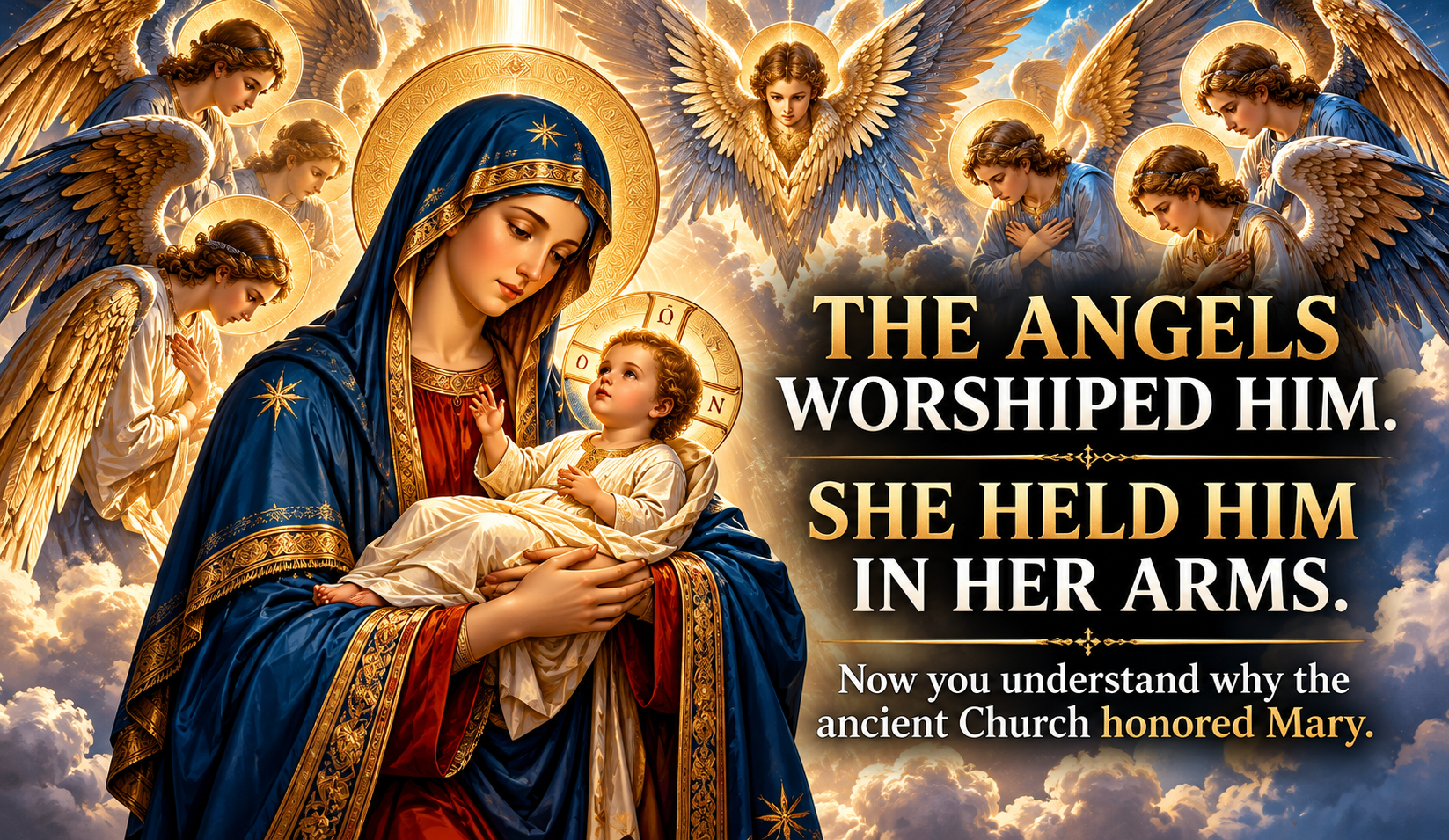
The angels stand before God’s throne and worship Him.
Mary carried within her womb the very God whom the angels worship.
The seraphim proclaim His holiness. Mary gave Him human flesh.
The cherubim are associated with His heavenly throne. Mary became the living dwelling place of God the Word.
This does not mean Mary is divine. She is a human being, entirely dependent upon God’s grace, just as we are.
It means that through God’s extraordinary calling and her willing cooperation, she received an honor unlike any other human person.
And that distinction brings us directly to the Old Testament.
2. The Ark of the Covenant: The Old Testament’s Extraordinary Foreshadowing of Mary
One of the most beautiful connections between the Old and New Testaments is something many Christians have never been taught.
The early Church came to understand Mary as the living Ark of the New Covenant.
Consider what the original Ark represented.
In Exodus 25:10-22, God instructed Moses to construct a sacred chest overlaid with pure gold. Above its mercy seat were two cherubim with outstretched wings.
God declared that He would meet with Moses there, above the mercy seat, between the cherubim.
The Ark was associated with God’s holy presence among His people.
According to Hebrews 9:4, the Ark contained the tablets of the covenant, a golden vessel containing manna, and Aaron’s rod that budded.
Each of these carried profound spiritual significance.
But when the fullness of time arrived, something even more extraordinary happened.
God did not merely reveal His presence from above a sacred object.
He entered human history by taking flesh from a young Jewish virgin.
And the parallels are remarkable.
The Old Covenant Ark and Mary
| The Ark of the Covenant | The Virgin Mary |
|---|---|
| Held the tablets of God’s Law | Bore Christ, the eternal Word of God (John 1:14) |
| Contained manna from heaven | Bore Christ, the Bread of Life (John 6:35) |
| Held Aaron’s priestly rod | Bore Christ, our eternal High Priest (Hebrews 4:14) |
| Overshadowed by God’s glory (Exodus 40:34-35, concerning the Tabernacle) | Overshadowed by the Holy Spirit (Luke 1:35) |
We must be careful here. These are theological correspondences, not an explicit statement in the Bible that Mary is the Ark. But these connections are deeply rooted in how ancient Christians read Scripture.
And the Gospel of Luke provides something even more compelling.
The surprising connection between David and Elizabeth
In 2 Samuel 6:9, King David approaches the Ark of the Covenant and asks:
“How can the ark of the Lord come to me?”
Now turn to Luke 1:43.
When Mary visits Elizabeth, Elizabeth exclaims:
“And why is this granted me, that the mother of my Lord should come to me?”
Notice the similarity.
David wonders how the Ark of the Lord could come to him.
Elizabeth wonders how the Mother of her Lord could come to her.
The parallels continue.
In 2 Samuel 6:14-16, David leaps and dances before the Ark.
In Luke 1:41-44, John the Baptist leaps in Elizabeth’s womb at Mary’s arrival.
The Ark remains in the house of Obed-Edom for three months in 2 Samuel 6:11.
Mary remains with Elizabeth for approximately three months in Luke 1:56.
These connections are difficult to dismiss as mere coincidence.
Luke appears to be presenting Mary through the language and imagery of Israel’s most sacred object.
And there is something else.
In Exodus 40:35, the glory of the Lord overshadows the Tabernacle.
In Luke 1:35, Gabriel tells Mary:
“The Holy Spirit will come upon you, and the power of the Most High will overshadow you.”
The Greek verb translated “overshadow” is episkiazō, a term that also appears in the Greek Old Testament’s description of the divine cloud over the Tabernacle.
This is not insignificant.
The same divine presence once manifested over the Tabernacle now acts within Mary as the eternal Son takes on human flesh.
The Ark was holy because of the presence of God.
Mary is honored because the God of Israel personally dwelt within her.
And unlike the Ark, Mary was not an object made from gold and wood.
She was a living human being who freely answered God’s invitation with faith and obedience.
3. The Burning Bush: How Can Fire Dwell Without Consuming?
Another Old Testament image becomes especially meaningful when viewed through the mystery of the Incarnation.
In Exodus 3:2, Moses encounters a burning bush.
The bush is engulfed in fire, yet it is not consumed.
This is the moment in which God reveals Himself to Moses and prepares to deliver Israel from bondage.
For the Orthodox Church, the burning bush also becomes an image of the Virgin Mary.
Why?
Because Mary carried within herself the One whom Scripture describes as a consuming fire (Deuteronomy 4:24; Hebrews 12:29).
Yet she was not destroyed.
The uncreated God entered His creation, taking flesh from her, without consuming her humanity.
This imagery became a significant part of Orthodox hymnography.
What makes it so beautiful is that the symbolism does not stop with Mary.
It reveals something profound about salvation itself.
God did not become man merely to deliver religious instructions.
He became man to heal and restore human nature, to unite humanity to Himself, and to make possible our participation in divine life through grace.
The burning bush anticipates a central truth of Orthodox theology.
God’s presence does not destroy the humanity He created. His grace heals, sanctifies, and transforms it.
Mary becomes the supreme human example of this mystery because the Incarnation took place within her womb.
And this brings us to another prophecy.
4. Isaiah’s Prophecy: The Virgin Who Would Bear Emmanuel
Approximately seven centuries before Christ, the prophet Isaiah declared:
“Behold, a virgin shall conceive and bear a son, and shall call his name Immanuel” (Isaiah 7:14).
Christians have long understood this prophecy in connection with the birth of Jesus, as Matthew explicitly does in Matthew 1:22-23.
The name Emmanuel means “God with us.”
Notice what this means.
Mary did not simply give birth to an unusually righteous man who later became God’s representative.
She gave birth to Jesus Christ, who is God the Son incarnate.
This is precisely why the ancient Church called her Theotokos, meaning “God-bearer” or “Mother of God.”
It does not mean Mary created God’s divine nature.
It does not mean she existed before God.
And it certainly does not mean she is a goddess.
It means that the person born from her is God the Word, who became truly human without ceasing to be truly divine.
St. John of Damascus, writing in the eighth century, explained that Mary had been foreshadowed through prophetic images and that she rightly bears the title Mother of God because of the identity of the One she bore.
This distinction is absolutely essential.
If Jesus is truly God, and Mary is truly His mother according to His humanity, then calling her the Mother of God safeguards the mystery of the Incarnation.
Refusing that title because it sounds too exalted can unintentionally create confusion about who Jesus really is.
And this was not merely a theological debate among medieval monks.
It was an issue that the early Church addressed centuries earlier.
5. The Earliest Church Fathers: Mary as the New Eve
One of the strongest pieces of evidence that the early Church understood Mary as having a unique role in salvation history comes from St. Irenaeus of Lyons.
Irenaeus lived in the second century, approximately AD 130 to 202.
His historical connection to the apostolic Church is particularly important. He had known St. Polycarp, who himself had been associated with the Apostle John.
In other words, Irenaeus was not a medieval theologian inventing new beliefs about Mary.
He belonged to a generation of Christians remarkably close to the apostles.
In his work Against Heresies, Book III, Chapter 22, Irenaeus drew an extraordinary comparison between Eve and Mary:
“For what the virgin Eve had bound fast through unbelief, this did the virgin Mary set free through faith.”
Think about what he was saying.
The first Eve listened to the serpent and disobeyed God.
Mary listened to the angel Gabriel and obeyed God.
Through Eve’s disobedience, humanity fell into sin and death.
Through Mary’s obedience, the Savior entered the world to conquer sin and death.
Of course, Irenaeus was not suggesting that Mary saved humanity independently of Christ.
Christ alone is the Savior.
Rather, he recognized that Mary freely cooperated with God’s saving work in a way that reversed Eve’s response.
This is what the early Church understood as the New Eve.
And there is a powerful spiritual lesson here.
God did not force Mary to become the Mother of the Savior.
When Gabriel announced that she would conceive by the Holy Spirit, Mary responded:
“Behold the handmaid of the Lord; be it unto me according to thy word” (Luke 1:38).
Her response was an act of extraordinary humility, faith, and obedience.
And this is something we sometimes miss.
Mary’s greatness is not merely that she gave birth to Jesus. Her greatness also includes her willingness to surrender herself completely to the will of God.
In a world obsessed with personal independence and self-determination, Mary reveals another path.
The path of holiness begins when we stop insisting that God conform to our plans and begin surrendering ourselves to His.
6. The Church Fathers Were Not Embarrassed to Call Mary the Mother of God
By the fourth century, the title Theotokos was already an important expression of Christian belief.
Consider St. Gregory the Theologian, also known as Gregory of Nazianzus.
Writing around AD 382 in his famous Letter 101 to Cledonius, Gregory made a striking declaration:
“If anyone does not believe that Holy Mary is the Mother of God, he is severed from the Godhead.”
Those are strong words.
Why would one of the greatest theologians in Christian history make such a statement?
Because Gregory understood that the title Mother of God was ultimately about Christ.
The person Mary bore was not merely a human being later joined to God.
He was the eternal Son of God who assumed a complete human nature.
Mary did not give birth to the divine nature, which is eternal and uncreated. She gave birth according to the flesh to the divine Person of the Son.
And Gregory was defending precisely this unity of Christ.
We find similar teaching in St. Ephrem the Syrian, who died in AD 373.
Ephrem was one of the ancient Church’s greatest hymnographers, and his poetry reveals how deeply the mystery of Mary and the Incarnation had entered Christian worship.
In his Hymns on the Nativity, he celebrated Mary as the woman who carried the infinite Lord within the confines of her womb.
He marveled that the One whom heaven and earth cannot contain had chosen to dwell within a human mother.
Ephrem’s theology was not simply intellectual.
It was worshipful.
He understood that the Incarnation should fill Christians with awe.
And that brings us to AD 431.
The Council of Ephesus did not invent the title Theotokos
I have sometimes heard Christians suggest that Mary became the Mother of God at the Council of Ephesus in 431.
That is historically incorrect.
The title and its theological meaning existed before the council.
The controversy arose because Nestorius, the Archbishop of Constantinople, objected to the way Theotokos was being used and preferred language emphasizing Mary as the Mother of Christ.
St. Cyril of Alexandria insisted that the title Theotokos protected the truth that Jesus Christ is one divine Person, not two separate personal subjects.
The Council of Ephesus affirmed the orthodox teaching.
It declared that the Virgin Mary could rightly be called the Mother of God because the One born from her in the flesh is the eternal Word of God.
The council was not elevating Mary into divinity.
It was defending the divinity of her Son and the reality of His Incarnation.
The council’s surviving acts preserve these theological arguments and their scriptural foundations.
I want you to recognize what this means.
When Orthodox Christians call Mary Theotokos, we are not adding something to Jesus Christ.
We are confessing something essential about Him.
And when we honor Mary, we are acknowledging the extraordinary mystery that God truly became one of us.
7. Archaeology: What Ancient Christian Discoveries Reveal About Mary
This is where our discussion becomes especially fascinating.
We have examined Scripture and the writings of the Fathers.
But is there physical evidence that Christians honored Mary in the early centuries?
Yes.
And some of these discoveries are remarkable.
The Catacombs of Priscilla: An ancient image of Mary and Jesus

Beneath the streets of Rome lies the Catacomb of Priscilla, an ancient Christian burial complex containing some of the earliest surviving examples of Christian religious art.
Among its remarkable paintings is an image traditionally identified as the Virgin Mary holding the Christ Child beside a figure commonly interpreted as the prophet Balaam.
A star appears above the scene.
The connection with Balaam is particularly interesting because Numbers 24:17 contains the prophecy:
“There shall come a Star out of Jacob, and a Sceptre shall rise out of Israel.”
Christians understood this as pointing toward the coming of the Messiah.
The Vatican’s Pontifical Commission for Sacred Archaeology identifies the image as one of the earliest representations of the Mother of God in the West, dating it to approximately AD 230 to 240.
Think about that.
Only about two centuries after Christ, Christians were already representing Mary and the Christ Child in sacred imagery.
This is powerful evidence that the Mother of Jesus had an established place in the visual and theological imagination of the ancient Christian community.
Now, we should not claim more than archaeology allows.
The painting does not prove that Christians in AD 230 were singing the exact hymn “More Honorable Than the Cherubim,” which was composed centuries later.
Nor does it establish every aspect of later Marian devotion.
But it does challenge the claim that honoring Mary through religious art was a late medieval invention.
An ancient prayer discovered in Egypt: Sub Tuum Praesidium

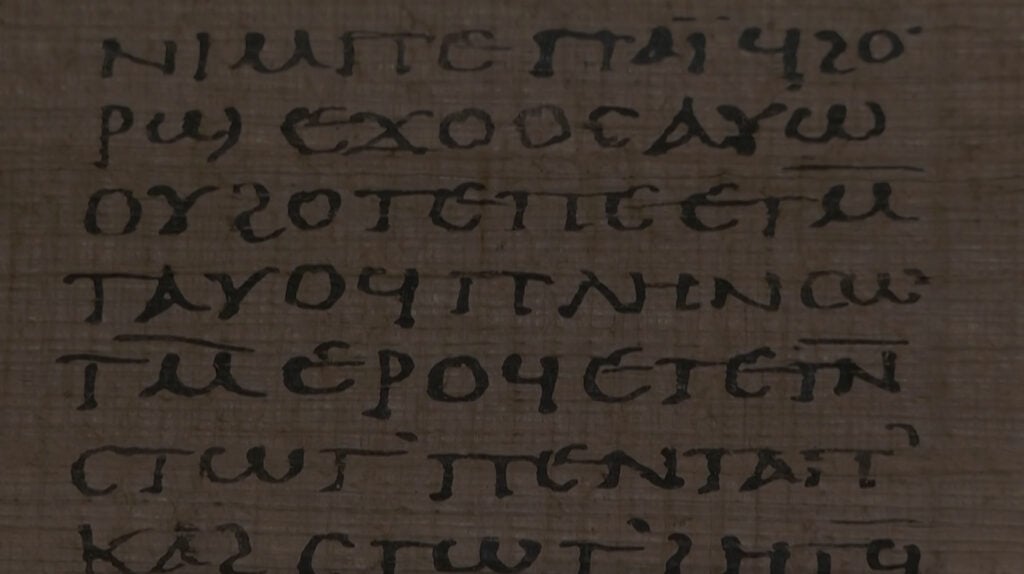
Another important discovery is a Greek papyrus known as Sub Tuum Praesidium, preserved as John Rylands Papyrus 470.
It contains an ancient Christian prayer addressed to the Mother of God.
The prayer begins:
“Under your mercy we take refuge, O Mother of God.”
It continues by asking for deliverance from danger and distress.
This is significant for two reasons.
First, the prayer uses the title Theotokos.
Second, it shows Christians invoking Mary’s intercession, something that many modern Christians assume developed much later.
There is an important scholarly qualification concerning its date.
The papyrus has traditionally been assigned to the third or fourth century, but its dating remains disputed. Some more recent paleographical assessments place the surviving manuscript considerably later.
What scholars can establish with confidence is that this prayer belongs to an ancient tradition of Marian devotion, although the surviving manuscript alone cannot prove that it was written in the apostolic age or even necessarily the third century.
Nevertheless, it provides another window into how Christians understood Mary’s place within the communion of the Church.
They did not worship her as a goddess.
They sought her prayers as the Mother of the Lord.
There is a difference, and that difference matters.
Dura-Europos: A possible early depiction of the Annunciation

At the ancient city of Dura-Europos in modern Syria, archaeologists discovered a third-century Christian house church that contains important early Christian paintings.
One depicts a woman drawing water from a well.
Traditionally, the scene has been associated with the Samaritan woman in John 4.
However, scholar Michael Peppard has argued that it may instead depict the Virgin Mary at the moment of the Annunciation, following an early Christian tradition that placed Gabriel’s initial encounter with Mary near a well.
This identification remains debated, and the scene cannot be treated as definitive proof of Marian iconography.
Yet it demonstrates how scholars continue to investigate the place of Mary in the earliest surviving Christian art.
Taken together, these artifacts are important.
They show that Marian imagery, theological reflection, and prayer have deep roots in ancient Christianity.
They do not establish that every later practice existed in identical form from the beginning.
What they reveal is a developing expression of a much older conviction: the woman who bore the incarnate Lord held an extraordinary place in the faith of the Church.
8. Mary Herself Prophesied That All Generations Would Call Her Blessed
Perhaps the most direct biblical justification for honoring Mary comes from her own lips.
In Luke 1:46-49, Mary declares:
“My soul doth magnify the Lord, and my spirit hath rejoiced in God my Saviour.”
Then she says something remarkable:
“For he hath regarded the low estate of his handmaiden: for, behold, from henceforth all generations shall call me blessed.”
Notice those words.
All generations shall call me blessed.
Not merely Elizabeth.
Not merely the apostles.
Not merely the first generation of Christians.
All generations.
And what is especially important is Mary’s explanation.
She does not claim that she has achieved greatness independently of God.
She declares:
“For he that is mighty hath done to me great things; and holy is his name.”
Mary’s honor points directly to God’s work.
This is the essence of authentic Orthodox devotion to the Theotokos.
When we magnify Mary, we are acknowledging the extraordinary things God has accomplished through her.
And this is why the hymn Axion Estin is so appropriate.
The Church does exactly what Mary said future generations would do.
It calls her blessed.
Not because Mary replaces Christ, but because Christ has done great things through her.
What about the woman clothed with the sun?
There is another biblical passage worth examining.
In Revelation 12:1, St. John describes a great sign in heaven:
“A woman clothed with the sun, and the moon under her feet, and upon her head a crown of twelve stars.”
The woman gives birth to a male child who is destined to rule the nations.
Orthodox interpreters recognize that this image has multiple dimensions.
The woman represents the people of God, Israel and the Church, from whom the Messiah comes. She can also be understood in relation to Mary, the actual mother of Jesus Christ.
These meanings need not exclude one another.
Biblical imagery often carries several interconnected levels of meaning.
We should not pretend that Revelation 12 is exclusively about Mary or that it offers a simple description of her heavenly status.
But within the Church’s theological understanding, its imagery contributes to the wider scriptural portrait of the Mother of God.
She is honored not apart from the people of God, but as the one through whom the Messiah entered history.
9. Does Honoring Mary Take Glory Away From Jesus?
This is probably the most important question in the entire discussion.
And I want to answer it directly.
No. Properly understood, honoring Mary does not diminish Jesus Christ.
It magnifies Him.
Think about the way we honor the saints.
When we celebrate St. Paul, are we taking glory away from Jesus?
Of course not.
We are acknowledging what the grace of God accomplished in Paul’s life.
When we honor the martyrs who gave their lives for Christ, are we competing with Christ?
No.
We are glorifying the Savior whose grace sustained their faithfulness.
Mary is honored according to the same basic principle, but her calling is unique.
No apostle, prophet, martyr, or angel was chosen to give human flesh to the eternal Word of God.
That honor belongs to her alone.
And the Church has always distinguished between the worship owed to God and the honor given to His saints.
Worship in the fullest sense belongs to the Holy Trinity alone.
Mary is venerated, not worshiped as divine.
She is a creature, not the Creator.
She is saved by her Son, not a rival source of salvation.
She is the Mother of God according to His humanity, not the origin of His eternal divinity.
And perhaps most importantly, she continually directs us toward her Son.
Remember her words at the wedding at Cana.
“Whatever he saith unto you, do it” (John 2:5).
Those words reveal the heart of the Theotokos.
She does not say, “Look at me instead of Him.”
She says, in effect, “Listen to my Son.”
That is why authentic Orthodox devotion to Mary is always Christ-centered.
And if our devotion ever becomes detached from Christ, we have misunderstood its purpose.
10. What Mary Teaches Us About Becoming Holy
I want to bring this down from ancient theology into our everyday lives.
Because the purpose of studying Mary is not simply to win a theological argument with a Protestant friend or to collect historical evidence for Orthodox beliefs.
The purpose is to understand what her life teaches us about our own relationship with God.
Mary’s life reveals three essential truths.
First, holiness begins with humility.
When Gabriel appeared, Mary did not insist upon her importance.
She called herself the handmaid of the Lord.
The woman whom the Church would one day call more honorable than the cherubim began by acknowledging herself as God’s servant.
That should tell us something.
In God’s Kingdom, greatness is inseparable from humility.
Second, faith requires obedience.
Mary did not understand everything that would happen.
She did not know all the suffering that awaited her.
She would eventually stand at the foot of the Cross and watch her Son die.
Yet she trusted God.
Her response was not based upon having every question answered.
It was based upon faith.
How often do we demand that God explain Himself before we are willing to obey?
Mary shows us a different way.
Third, we are called to become dwelling places of God.
The connection between Mary and the Ark of the Covenant is not merely an interesting historical observation.
It points toward our own spiritual calling.
St. Paul tells the Corinthians:
“Know ye not that ye are the temple of God, and that the Spirit of God dwelleth in you?” (1 Corinthians 3:16).
The same God who made His dwelling within Mary now calls His people to become temples of the Holy Spirit.
Not through the unique mystery of the Incarnation, which belongs to Mary alone, but through participation in Christ’s life by grace.
This is why the Church calls us to repentance, prayer, fasting, confession, and the Holy Eucharist.
These are not simply religious activities.
They belong to the life through which we are united to Christ and transformed by His grace.
Mary shows us what human cooperation with divine grace looks like when a person gives herself completely to God.
And that should inspire every one of us.
Conclusion: The Woman Who Carried Heaven Within Her Womb
When I first encountered Orthodox devotion to the Virgin Mary, I had to confront assumptions I had carried for years.
I had been taught to approach Marian language with suspicion.
And I understand why many Christians still do.
Some expressions of devotion can sound strange when we have never been taught the theology behind them.
But studying the Scriptures and the writings of the early Church Fathers changed how I understood the Mother of God.
I began to see that the ancient Christians were not trying to elevate Mary above Christ.
They were trying to express the astonishing reality of the Incarnation.
The God whom Moses encountered in the burning bush took flesh from her.
The divine presence that overshadowed the Tabernacle came upon her.
The eternal Word, through whom all things were created, entered the world through her womb.
The Savior promised by the prophets became truly human through her willing obedience.
And because of this, the Church honors her above the heavenly hosts.
Not because she is greater than God.
Not because she possesses divinity.
But because the eternal Son of God chose her to become His mother.
The cherubim surround the throne of God.
The seraphim proclaim His holiness.
But Mary held Him in her arms, nursed Him as an infant, and watched Him grow.
She stood beside His Cross.
And she remained faithful to the One who came to redeem humanity.
So when the Orthodox Church sings, “More honorable than the Cherubim, and beyond compare more glorious than the Seraphim,” we are not making a goddess out of Mary.
We are confessing the glory of the Incarnation.
And perhaps that is what we have forgotten in so much of modern Christianity.
We have become so accustomed to saying that God became man that we sometimes fail to appreciate how astonishing those words really are.
The Creator entered His creation.
The eternal entered time.
The One whom the heavens cannot contain entered the womb of a Virgin.
And the woman who said, “Be it unto me according to thy word,” became the Mother of our Lord.
That is why ancient Christians honored her.
That is why the Orthodox Church continues to magnify her.
And that is why, whenever we honor the Theotokos, our hearts should ultimately be lifted toward Jesus Christ, her Son and our Savior.
For everything beautiful about Mary is a testimony to the extraordinary grace of God.
And everything the Church says about her ultimately leads us back to the One she carried within her womb.
Christ our God, who became man for our salvation.
Would you like to go deeper into understanding the Theotokos?
Discover What the Ancient Church Really Believed About the Mother of God
Why did the earliest Christians honor Mary so deeply, and why do Orthodox Christians still pray, “Most Holy Theotokos, save us”?
For many Christians, especially those from Protestant backgrounds, these questions can be confusing, even troubling. But what if understanding the Theotokos actually brings us closer to understanding Jesus Christ?
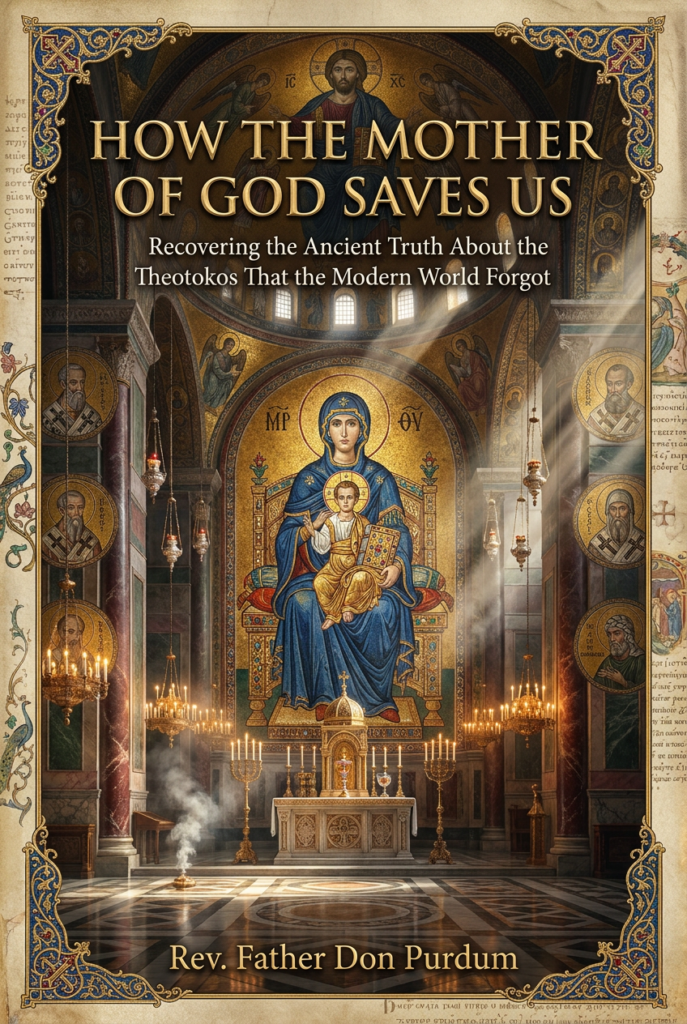
In my ebook, ** How the Mother of God Saves Us **, I explore the biblical foundations, ancient Christian writings, and teachings of the Church Fathers to reveal why honoring Mary has always been inseparable from glorifying her Son.
Discover the truth about the New Eve, the Living Ark of the Covenant, Mary’s intercession, and what the earliest Christians really believed.
Don’t let modern misconceptions keep you from discovering one of Christianity’s most beautiful ancient truths.
👉 Get Your Copy of How the Mother of God Saves Us Today
Want the entire article distilled into one clear, printable page?
Download your free summary and keep it with you.
Get the free PDF + join thousands of people receiving short, practical Orthodox insights in the “Morning Brew with Father Don” to help you grow in Christ each week.