Why do Orthodox Christians recite prayers written centuries ago? Does God prefer spontaneous prayer? Discover what Scripture, the early Church, and the Church Fathers teach about prayer, spiritual formation, and growing closer to Christ.
Imagine having a conversation with someone you love, but every time you speak, you say exactly the same words.
Wouldn’t that become meaningless?
This is one of the questions I frequently encounter when discussing Orthodox Christianity, particularly with Christians from evangelical and Protestant backgrounds.
Why do Orthodox Christians read prayers from a prayer book? Why do we recite prayers that were written hundreds, sometimes more than a thousand, years ago? Shouldn’t prayer come naturally from the heart? Doesn’t Jesus warn against repeating the same words over and over?
These are reasonable questions.
I understand them because, for many years, I approached prayer primarily as a spontaneous conversation with God. I believed that the most authentic prayers were those that came directly from my own thoughts, feelings, and experiences.
But as I began studying the early Church and eventually embraced Orthodox Christianity, I discovered something remarkable.
The ancient Christians did not view written prayers as a substitute for personal communication with God. They understood them as a means of teaching the heart how to pray.
And there is an important distinction.
Prayer is not simply about expressing what we already feel. Prayer is also about allowing God to transform what we feel, what we desire, and ultimately who we become.
This is why the Orthodox Church has preserved a treasury of prayers handed down through generations of faithful Christians.
These prayers do more than give us words to say.
They teach us how to become holy.
1. Jesus Himself Gave Us a Prayer to Recite
Perhaps the strongest argument for using established prayers comes directly from Jesus Christ.
When the disciples asked Him to teach them to pray, Jesus did not simply tell them to speak whatever came into their minds.
He gave them a prayer.
In Luke 11:2, Jesus says:
“When you pray, say: Our Father…”
Notice those words: When you pray, say.
Jesus provided His disciples with specific words to use when approaching God.
In Matthew 6:9, He introduces the same prayer by saying, “Pray then like this.”
Taken together, these passages show us that the Lord’s Prayer is both a pattern that teaches us how to pray and a prayer Christians can actually recite.
And think about what this prayer teaches.
We begin by acknowledging God as our Father. We submit ourselves to His will. We ask for what we need rather than everything we want. We acknowledge our sins and the responsibility to forgive others. We ask for protection against temptation and evil.
In other words, Jesus teaches us to pray according to God’s priorities rather than our own.
That is spiritual formation.
Left to ourselves, our prayers can easily become centered on our immediate problems, anxieties, desires, and circumstances.
But when we pray the Lord’s Prayer, we are reminded that our lives must be centered on God and His Kingdom.
The purpose of prayer is not to bring God into agreement with our will. It is to bring our will into agreement with His.
Jesus also prayed the same words repeatedly in the Garden of Gethsemane (Matthew 26:39–44). Repetition itself, therefore, cannot be what makes a prayer unacceptable.
2. Written Prayers Were Part of Christian Worship From the Beginning
One of the most fascinating discoveries about early Christianity is how quickly we encounter established patterns of prayer.
In fact, this practice did not originate with Christianity.
It was inherited from the Jewish worship in which Jesus and the apostles participated.
The Psalms were Israel’s great prayer book. They contained prayers of thanksgiving, repentance, lamentation, praise, and petitions for God’s mercy.
Jesus Himself prayed the words of Psalm 22 from the Cross:
“My God, my God, why have you forsaken me?” (Matthew 27:46)
These were not words Jesus invented in that moment. They came from the inspired prayers of Scripture.
Likewise, in Acts 3:1, Peter and John went to the Temple at the ninth hour, identified as an hour of prayer.
The early Christians were already familiar with regular times of worship, the singing of Psalms, and the use of established prayers.
Christianity did not abandon this inheritance. It fulfilled and transformed it in Christ.
The Didache: Evidence From the Earliest Generations
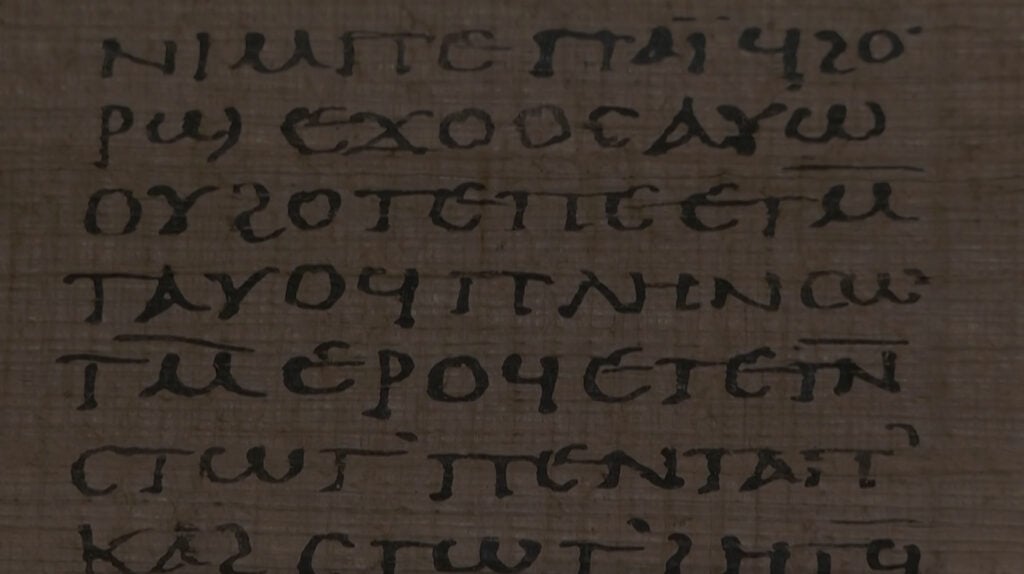
One of the clearest witnesses to early Christian prayer is the Didache , also known as The Teaching of the Twelve Apostles.
Generally dated to the late first or early second century, the Didache provides extraordinary insight into the worship and daily practices of the earliest Christians.
In chapter 8, Christians are instructed to pray the Lord’s Prayer three times every day.
This is significant.
Within the earliest generations of the Church, Christians were already practicing the regular recitation of an established prayer.
The same document also preserves prescribed prayers of thanksgiving associated with the Eucharistic meal in chapters 9 and 10.
It demonstrates that structured prayer was not a medieval invention or a later corruption of Christian spirituality.
It belonged to the life of the ancient Church.
Prayer in the Second and Third Centuries
The early Christian writer Tertullian, writing around the beginning of the third century, discusses regular prayer at the third, sixth, and ninth hours of the day, alongside prayers at the beginning and end of the day.
In his treatise On Prayer, chapter 25, he explains that such regularity draws Christians away from daily occupations and back toward God.
This tells us something important about the purpose of prayer.
The early Christians understood that prayer needed to become part of the rhythm of life.
They did not simply pray when they felt inspired.
They established habits that helped them remember God throughout the day.
By the Fourth Century, Liturgical Prayer Was Deeply Established
St. Cyril of Jerusalem provides another important witness.
In his Mystagogical Catechesis 5, delivered in the fourth century, he explains the prayers and responses used during the Eucharistic Liturgy.
He describes the priest calling the congregation to lift their hearts to God, the people’s response, the thanksgiving, the intercessions, and the Lord’s Prayer.
These were recognizable forms of communal worship.
The Church had established prayers that taught Christians how to participate in the divine mysteries.
The precise wording and arrangement of Christian liturgies developed over time, but the historical evidence is unmistakable: shared and established prayer was integral to ancient Christian worship.
3. What Did the Church Fathers Teach About Established Prayers?
The Church Fathers consistently emphasized that prayer requires more than the movement of our lips.
It requires attention, humility, repentance, and the participation of the heart.
But they did not regard established prayers as obstacles to these things.
Quite the opposite.
Tertullian: Established Prayers Give Us a Foundation
In On Prayer, chapter 10, Tertullian explicitly addresses the relationship between the Lord’s Prayer and personal petitions.
He explains that Christians may add their own petitions according to their particular circumstances, building upon the customary prayers as a foundation.
This is an extraordinary early witness to the balance between established and spontaneous prayer.
Christians were not expected to choose one or the other.
They could pray the words given by Christ and then express their individual needs before God.
The established prayer provided spiritual guidance, while personal petitions allowed believers to bring their particular burdens before the Lord.
St. Cyprian of Carthage: Our Hearts Must Agree With Our Words
St. Cyprian, writing in the third century, warned Christians against allowing their minds to wander during prayer.
In his treatise On the Lord’s Prayer, section 31, he explains that when we pray, the heart and mind must be directed toward God.
His concern was not that Christians used established words.
His concern was that they might recite those words without paying attention to their meaning.
He warned against having one thing in our hearts and another in our voices.
Here we discover an essential Orthodox principle.
A prayer does not become meaningless because we have prayed it before. It becomes empty when we refuse to engage our hearts in what we are saying.
St. Cyril of Jerusalem: Prayer Must Become an Inner Reality
St. Cyril explains that during the Divine Liturgy, the priest calls the people to lift their hearts to the Lord.
The congregation responds with words affirming that their hearts are lifted toward God.
But Cyril warns that these words must correspond to their actual spiritual condition.
It is not enough for the mouth to declare that the heart is directed toward heaven while the mind remains consumed by earthly concerns.
The words are meant to draw the worshipper into the spiritual reality they express.
That is precisely why established prayers are so important.
They teach us to direct our hearts toward heaven, even when our attention is struggling to follow.
4. How the Prayers of the Church Form and Transform the Soul
This brings us to what I believe is the most important reason Orthodox Christians pray established prayers.
We do not pray simply to tell God what is happening in our lives. We pray so that God can transform our lives.
There is a profound difference between those two purposes.
Consider how we learn almost anything important.
A musician practices scales long before performing a beautiful piece of music. An athlete repeats the same movements countless times to develop skill and discipline. A child learns language by repeating words spoken by parents and teachers.
Repetition is not necessarily the enemy of authenticity.
Very often, repetition is how something becomes part of who we are.
The spiritual life works in a similar way.
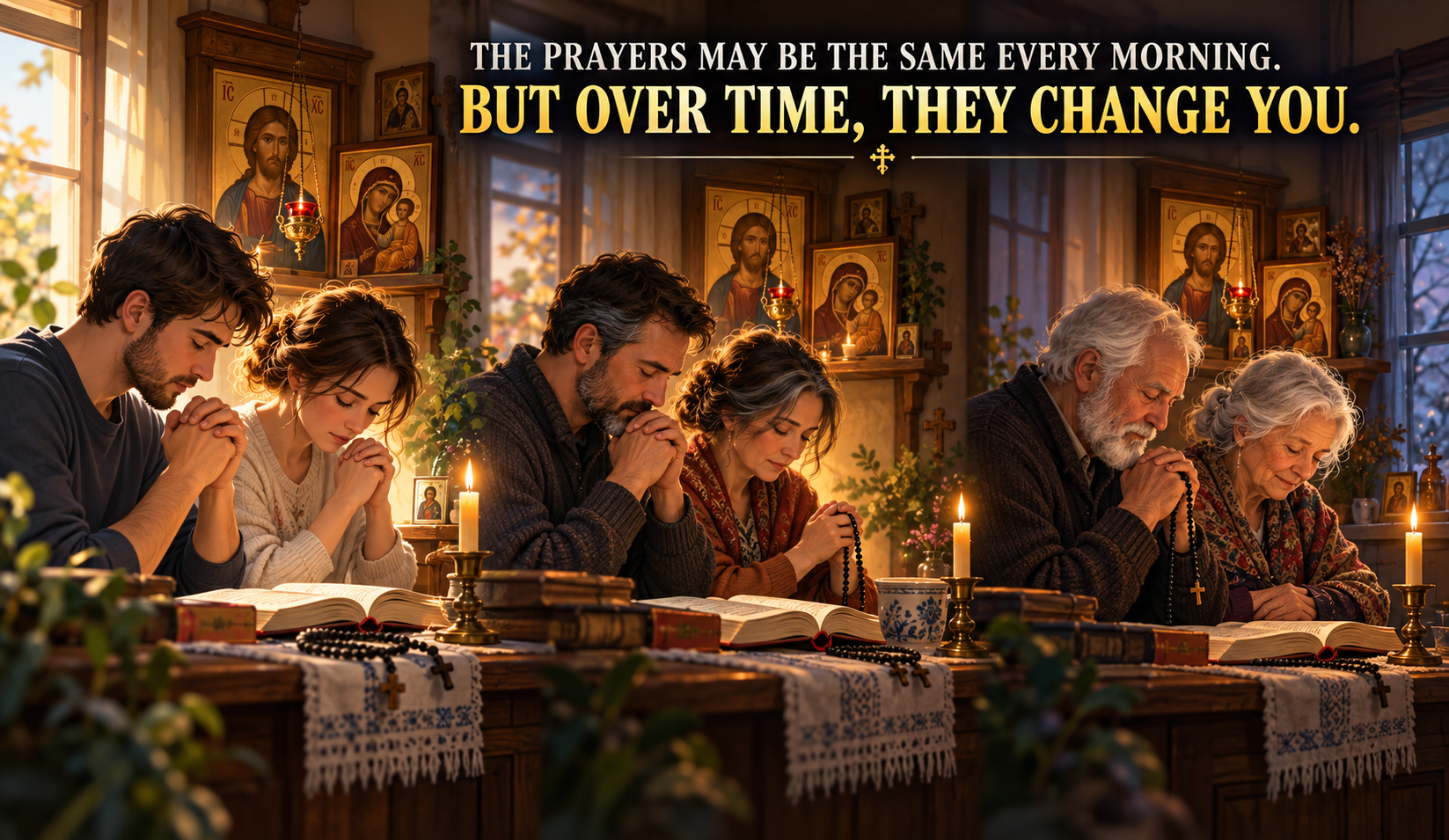
When we repeatedly pray the words handed down through the Church, those words begin to shape our spiritual instincts.
Written Prayers Teach Us Humility
Think about one of the most familiar prayers in Orthodox Christianity, the Jesus Prayer:
“Lord Jesus Christ, Son of God, have mercy on me, a sinner.”
This short prayer contains an entire theology of salvation.
We confess that Jesus is Lord. We acknowledge that He is the Son of God. We recognize our need for mercy. We admit our sinfulness.
Now imagine praying these words every morning, throughout the day, and before going to sleep.
Over time, they can cultivate something essential to spiritual maturity: humility.
Rather than constantly defending ourselves, justifying our behavior, or blaming others, we begin to recognize our need for God’s mercy.
The Jesus Prayer teaches us to approach God not with a sense of entitlement but with repentance and dependence upon His grace.
The Orthodox tradition does not treat the prayer as a magical formula. Its purpose is communion with Christ through attentive, humble prayer.
Written Prayers Teach Us to Repent
One of the great dangers of the spiritual life is that we become comfortable with our sins.
We excuse our anger. We justify our pride. We minimize our selfishness. We overlook our lack of compassion.
But the prayers of the Church continually confront us with the truth about ourselves.
Consider the Prayer of St. Ephrem the Syrian, especially familiar during Great Lent.
In a common English translation, we ask God to take away the spirit of idleness, despondency, lust for power, and idle talk.
We then ask Him to give us chastity, humility, patience, and love.
And finally, we ask that we might see our own transgressions and not judge our brother.
This is remarkable.
Many of us naturally want to pray about what is wrong with other people.
The Prayer of St. Ephrem teaches us to begin with what needs to change in ourselves.
And when these words are prayed repeatedly, especially alongside fasting, confession, and acts of repentance, they become a means of spiritual examination.
They challenge us to recognize our sins rather than excuse them.
They call us toward a life of holiness.
Written Prayers Teach Us to Love Others
Something else happens when we pray the prayers of the Church.
Our spiritual world becomes larger.
If we only pray spontaneously, there is a temptation for our prayers to revolve almost entirely around our personal concerns.
We pray for our families, our finances, our health, our work, and our problems.
There is nothing wrong with bringing these things before God.
In fact, we should.
But the Church teaches us to pray for far more.
During the Divine Liturgy, we pray for the peace of the whole world, the stability of the holy Churches of God, those who govern, the sick, the suffering, travelers, captives, and those in need.
We pray for people we have never met.
We pray for people whose struggles we do not understand.
And Christ commands us to pray even for our enemies.
These prayers continually expand our capacity to love.
They remind us that Christianity is not simply about my relationship with God.
We are members of the Body of Christ, called to love one another and carry one another’s burdens.
When I pray the prayers of the Church, my concerns are placed within the much greater life of the Church.
My prayer becomes less self-centered and more Christ-centered.
Written Prayers Teach Us Orthodox Theology
Here is something we sometimes overlook.
The prayers of the Church are also a form of theological education.
Every time we participate in the Divine Liturgy, we confess truths about God, salvation, the Incarnation, the Holy Trinity, the Resurrection, and the life of the world to come.
Consider the Trisagion Hymn:
“Holy God, Holy Mighty, Holy Immortal, have mercy on us.”
In these words, we confess the holiness, power, and immortality of God while acknowledging our dependence upon His mercy.
Or consider the Nicene Creed, which we confess together during the Divine Liturgy.
It is not technically a prayer of petition, but its recitation is an act of worship and confession.
Through it, the faithful repeatedly proclaim the fundamental truths of Christianity.
This is one reason the Orthodox Church does not separate theology from worship.
What we believe shapes how we pray, and how we pray continually reinforces what we believe.
The Church’s prayers help protect us from reducing Christianity to our individual opinions, experiences, or preferences.
They place our spiritual lives within the apostolic faith preserved by the Church.
5. Why Repetition Is Essential to Spiritual Maturity
There is another important dimension to this discussion.
Spiritual maturity does not happen overnight.
It develops through a lifetime of repentance, prayer, obedience, participation in the sacraments, and cooperation with the grace of God.
St. John Climacus, the author of The Ladder of Divine Ascent, understood the importance of disciplined prayer.
In Step 28, he teaches the importance of preparing for appointed times of prayer through the continual remembrance of God.
The Orthodox Church has long understood that regular prayer is not merely a spiritual exercise we perform.
It helps establish the conditions in which we learn watchfulness, patience, self-control, and attentiveness to God.
Prayer Reorients Our Attention
Think about how much of our daily lives is spent reacting to the world around us.
We wake up and immediately check our phones.
We read disturbing headlines.
We become distracted by responsibilities, social media, disagreements, and worries about the future.
Before long, our minds are filled with everything except God.
A consistent rule of prayer interrupts that pattern.
Morning prayers remind us that the day belongs to God.
Evening prayers call us to examine our conscience, repent, give thanks, and entrust ourselves to His care.
Brief prayers throughout the day continually return our attention to Christ.
This is one of the reasons St. Paul commands us to “pray without ceasing” (1 Thessalonians 5:17).
The goal is not merely to recite words continuously.
The goal is to cultivate a heart that increasingly lives in the presence of God.
Prayer Forms Us Even When We Do Not Feel Like Praying
There is a misconception that prayer is only meaningful when we feel spiritually inspired.
But what happens when we do not feel like praying?
What happens when we are exhausted, discouraged, distracted, anxious, or spiritually dry?
Should we simply stop?
Of course not.
And this is where an established prayer rule becomes extraordinarily valuable.
When we do not know what to say, the Church gives us words.
When our emotions are unsettled, the Church provides a steady pattern.
When our minds are distracted, the prayers invite us to return our attention to God.
There have been times in my own spiritual journey when prayer came easily, and other times when it required discipline.
But one thing I have learned is that spiritual growth cannot depend entirely upon how I feel in any given moment.
Love is not sustained by emotion alone.
Neither is prayer.
Sometimes the simple act of faithfully standing before God, even when we feel nothing extraordinary, is an expression of love, trust, and perseverance.
That is not hypocrisy.
It can be an important part of spiritual maturity.
6. Doesn’t Jesus Warn Against Repetitive Prayer?
This is probably the most common biblical objection to established prayers.
In Matthew 6:7, Jesus warns against using empty phrases in prayer, as though God will hear us because of the number of words we speak.
Some Christians interpret this to mean that all repeated prayers are wrong.
But that interpretation creates a problem.
Jesus Himself gave His disciples the Lord’s Prayer.
He prayed repeatedly in Gethsemane.
And Scripture contains numerous examples of repeated phrases in worship.
Psalm 136 repeats the refrain about God’s enduring mercy throughout the entire psalm.
In Isaiah 6:3, the heavenly beings proclaim:
“Holy, holy, holy is the LORD of hosts.”
In Revelation 4:8, the heavenly worship likewise includes the continual proclamation of God’s holiness.
Clearly, repetition itself is not the problem.
Jesus condemns empty, mechanical prayer and the belief that multiplying words can manipulate God. He does not condemn the sincere repetition of holy words.
The distinction is not between written and spontaneous prayer.
The distinction is between prayer offered with attention and faith, and prayer performed without genuine devotion.
A spontaneous prayer can be just as empty as a memorized one.
We can speak many original words while thinking very little about God.
Likewise, we can pray the Lord’s Prayer for the thousandth time and experience a renewed awareness of God’s holiness, mercy, and love.
The question is not whether we have said the words before.
The question is whether we are truly praying them now.
7. Is Spontaneous Prayer Acceptable in Orthodox Christianity?
Absolutely.
Orthodox Christianity does not teach that Christians may only use written prayers.
Spontaneous prayer has an important place in the Christian life.
We can speak to God about our fears, struggles, temptations, gratitude, joys, and personal needs.
When someone we love is suffering, we can immediately ask Christ to have mercy.
When we receive good news, we can spontaneously thank God.
When we are tempted, we can cry out for His help.
When we are overwhelmed, we can simply say, “Lord, help me.”
There is nothing un-Orthodox about any of this.
In fact, these spontaneous expressions of prayer can become more meaningful when they are grounded in the spiritual wisdom of the Church.
As we saw earlier, Tertullian explicitly encouraged personal petitions built upon the foundation of established prayers.
The Orthodox Church continues to affirm this balance. Its spiritual teaching encourages both traditional prayers and personal prayer in one’s own words.
Written Prayer and Spontaneous Prayer Are Not Competitors
I like to think of the relationship this way.
Written prayers teach us the language of the spiritual life.
Spontaneous prayers allow us to use that language in the particular circumstances of our daily lives.
One forms us.
The other gives expression to what is happening within us.
Both are important.
Consider a Christian who has spent years praying the words of the Church, learning humility, repentance, thanksgiving, and trust.
When that person spontaneously prays during a crisis, the prayer is likely to reflect the spiritual wisdom that has been cultivated over those years.
The prayer becomes more than a request for God to fix the immediate problem.
It can become an act of surrender to His will.
This is one of the great gifts of Orthodox spirituality.
The prayers handed down to us by the saints gradually teach us how to pray even when we are not reading from a prayer book.
8. How to Begin Practicing an Orthodox Rule of Prayer
If you are new to Orthodox Christianity, the idea of following a daily prayer rule may seem unfamiliar.
But it does not need to be complicated.
In fact, one of the most important principles of an Orthodox prayer rule is consistency.
A small rule practiced faithfully is often more spiritually beneficial than an ambitious rule that is quickly abandoned.
Here is a simple pattern you can begin discussing with your priest or spiritual father.
Morning Prayer
Begin with the Sign of the Cross and a moment of silence. Pray the Trisagion prayers and the Lord’s Prayer, read a short morning prayer, and ask God to guide your thoughts, words, and actions throughout the day.
Prayer Throughout the Day
Practice the Jesus Prayer whenever you have a quiet moment. Before beginning a task, ask God for wisdom. When you encounter difficulty, ask for mercy and strength. Give thanks for the blessings you receive.
Evening Prayer
Spend a few minutes reflecting on the day. Thank God for His blessings. Acknowledge your sins and ask forgiveness. Pray for your family, your parish, and those in need. Entrust yourself to God’s protection before sleeping.
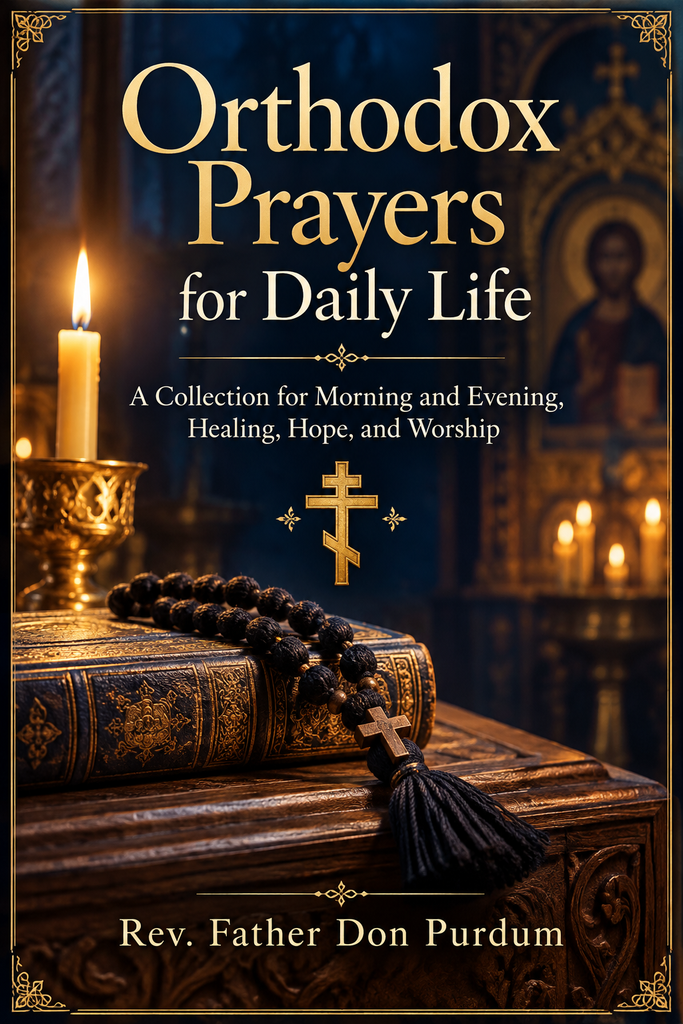
A prayer book can guide you through this process.
Recently, I compiled a list of over 200 morning prayers that I posted every morning on Facebook (I post one every morning).
If you want to learn more about them or get your copy, Click Here
A prayer rule is not a competition.
Its purpose is not to accumulate a certain number of prayers or prove how spiritual we are.
Its purpose is to help us develop a consistent life of communion with God.
As we grow spiritually, our prayer rule may change under the guidance of our priest.
What matters is not the quantity of words but the transformation of the heart.
9. The Ultimate Purpose of Prayer Is Union With God
This is where Orthodox spirituality offers something profoundly different from an understanding of prayer that focuses primarily on requesting things from God.
The Orthodox Church understands salvation as a life of growing communion with God.
The Fathers speak of theosis, or participation in the divine life by grace.
As St. Peter writes, we are called to become “partakers of the divine nature” (2 Peter 1:4).
This does not mean we become God by nature.
It means that through Christ and the grace of the Holy Spirit, we are increasingly transformed into His likeness.
Prayer plays an essential role in this process.
Through prayer, we learn humility.
Through prayer, we learn repentance.
Through prayer, we grow in gratitude.
Through prayer, we cultivate attentiveness to God.
And through prayer, we gradually learn to surrender our lives to His will.
The prayers of the Church are not ends in themselves. They serve this deeper purpose of communion with God, a communion expressed through loving obedience and participation in the life of Christ.
But we must remember something important.
Prayer is not a technique for manufacturing holiness.
We cannot force spiritual transformation through repetition alone.
It is God who transforms us through His grace.
Our responsibility is to cooperate with that grace through faith, repentance, prayer, obedience, and participation in the sacramental life of the Church.
The words of the saints help us do precisely that.
They teach us how to stand before God with humility and how to open our hearts to His transforming presence.
Conclusion: Sometimes We Need the Church to Teach Our Hearts What to Say
I want to leave you with a final thought.
There will be days when you do not know how to pray.
Perhaps you are grieving.
Perhaps you are overwhelmed.
Perhaps you are struggling with sin, loneliness, anger, or disappointment.
Perhaps you feel so spiritually exhausted that even speaking to God seems difficult.
In those moments, the prayers of the Church become a tremendous gift.
You do not have to invent the perfect words.
You do not have to manufacture the right emotion.
You can simply open your prayer book and begin.
You can pray the words of Christians who struggled, suffered, repented, and persevered long before you were born.
You can join your voice to the prayers of the Church across the centuries.
And as you continue faithfully, something beautiful can begin to happen.
The words that once seemed unfamiliar become your own.
The repentance expressed in those prayers becomes the repentance of your heart.
The humility expressed in those prayers begins to shape your character.
The love expressed in those prayers begins to influence how you treat others.
And the communion with God for which those prayers long becomes the deepest desire of your soul.
That is why Orthodox Christians pray written prayers.
Not because God needs us to repeat ancient words.
Not because spontaneous prayer is forbidden.
And certainly not because we believe that holiness can be achieved by mechanical repetition.
We pray these prayers because the Church, in her wisdom, knows that before we can learn to pray as we ought, we must first allow ourselves to be taught.
And who better to teach us than Christ Himself, the Holy Scriptures, and generations of saints who devoted their lives to knowing Him?
The next time you open your Orthodox prayer book, remember this:
You are not simply repeating the words of the past.
You are learning to pray with the mind of the Church.
And through the grace of God, you are allowing those prayers to form within you the mind and heart of Christ.
Want the entire article distilled into one clear, printable page?
Download your free summary and keep it with you.
Get the free PDF + join thousands of people receiving short, practical Orthodox insights in the “Morning Brew with Father Don” to help you grow in Christ each week.